September 2nd 2026
More Than a 3D Model: Bringing Real-World Plant Experience into the Classroom
How Interactive Virtual Plants Bring Real-World Training into the Classroom
For most students and trainees, gaining practical experience on a real process plant is extremely difficult.
Access may be restricted by safety requirements, operational demands, location or cost. Yet understanding how an industrial plant is arranged, and how its equipment, systems and people work together is an important part of preparing learners for industry.
TSC’s 3D Interactive Virtual Plants help bridge this gap by bringing a highly realistic industrial environment into the classroom.
More than a basic 3D model
Realism is about more than accurately reproducing the main process equipment.
A convincing virtual plant also includes the surrounding structures, access routes, buildings, environmental conditions and everyday objects that learners would encounter on a real industrial site. From changing weather and lighting conditions to signs, barriers, pipe supports and racks, safety showers and muster points, each detail contributes to an environment that feels credible and complete.
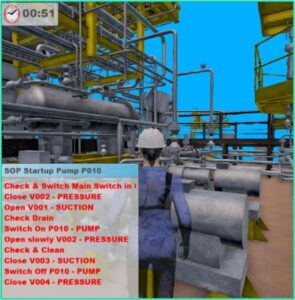
This attention to detail is something education and training customers regularly highlight when using TSC’s virtual plants. Rather than exploring a simplified collection of equipment, learners can move through an environment that reflects the scale and complexity of a real working plant.
Explore, interact and learn
Learners can navigate around the plant, locate equipment, read indicators, operate valves and interact with switches and controls.
However, the experience is not simply a visual walkthrough. TSC combines immersive 3D environments with dynamic process simulation, allowing actions taken in the virtual plant to affect the simulated process.
Field and control-room operators can work together to complete exercises such as start-up, shutdown and root cause analysis of faults. Instructors can introduce pre-built and ad-hoc faults and scenarios, monitor sessions and assess how learners respond.
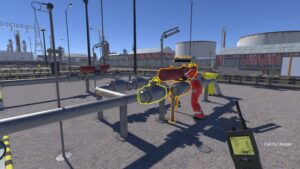
This helps students and trainees connect classroom theory with equipment, process behaviour and practical operating decisions, all within a safe and repeatable environment.
Flexible access for education and training
Interactive Virtual Plants can be used on Windows PCs, through the cloud or with compatible VR headsets. This makes them suitable for individual learning, classroom teaching, group exercises and immersive training facilities.
TSC offers a growing selection of ready-to-use virtual plants covering areas such as separation, green hydrogen production, tank farms, pipelines and compression.
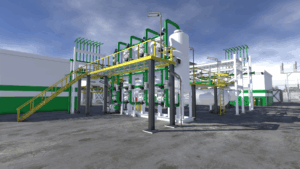
For organisations with more specific requirements, TSC can also create bespoke 3D environments based on a particular plant, process or training objective.
When access to a live plant is limited, realistic interactive training can give learners valuable experience of the environment they may one day be expected to work in.
Explore TSC’s Interactive Virtual Plants or speak to our team about a bespoke 3D training environment.
#InteractiveVirtualPlant #ProcessSimulation #VirtualTraining #EngineeringEducation #OperatorTraining #ChemicalEngineering #ProcessEngineering #ImmersiveLearning #VRTraining