October 6th 2026
How a Life Cycle Simulator Delivers Value Across Six Stages
Dynamic process simulation is often associated primarily with operator training. But its potential can begin much earlier and continue long after a plant has entered operation.
A Multi-Purpose Dynamic Simulator (MPDS), sometimes referred to as a Life Cycle Simulator, takes a different approach. Instead of developing a simulation for one specific requirement, the underlying dynamic process model can be used and developed throughout the design, engineering, commissioning, training and operational phases of a project.
The principle is simple: one simulation, multiple uses, greater value throughout the plant lifecycle.
At TSC Simulation, our dynamic simulation models and engineering studies can support projects across six key stages.
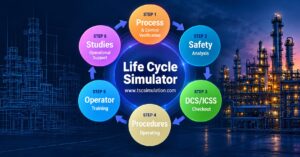
1. Process & Control Verification
The value of dynamic simulation can start during FEED and detailed engineering – well before there is an operating plant or a requirement to train operators.
Unlike steady-state simulation, dynamic simulation enables engineers to examine how a process responds as conditions change over time. This provides an opportunity to understand process interactions, investigate operating scenarios and test the proposed process and control philosophy before implementation.
The model can support studies including load balancing, anti-surge control and compressor studies, as well as the testing of sequences such as start-up, shutdown, changeover and bypass operations.
Identifying potential issues virtually at this stage can help reduce the requirement for later re-engineering and provide a more thoroughly tested foundation as the project progresses.
2. Safety Analysis
The same dynamic understanding of the process can also contribute to safety analysis.
Simulation can support HAZOP activities and allow engineers to investigate the integrity and response of safety systems under a range of conditions.
Shutdown philosophies and logic can be examined, Cause and Effect relationships validated and scenarios such as blowdown and depressurisation investigated before they need to be experienced on the real plant.
It also creates the opportunity to explore an important question safely: what happens when things don’t go according to plan?
The ability to investigate process behaviour without putting personnel, equipment or production at risk is one of the fundamental advantages of simulation throughout the lifecycle.
3. DCS/ICSS Checkout
As the project moves towards implementation, the simulation can take on another role.
Connecting the dynamic process model to the control system allows the proposed DCS or ICSS implementation to be tested against realistic process behaviour.
Control strategies, sequences, Cause and Effect implementation, alarms and operator graphics can be examined before plant start-up. PID controllers can also be pre-tuned using the simulated process.
Rather than waiting until commissioning to discover how the control system and process interact, many of those interactions can therefore be explored in advance.
This can help identify issues earlier, when they are generally easier to address, and reduce the amount of troubleshooting required during an already demanding commissioning period.
4. Developing and Testing Operating Procedures
A simulation that accurately represents the plant also provides a valuable environment in which to develop and refine operating procedures.
Start-up and shutdown procedures can be tested, start-up overrides examined, and the interaction required between operators, the DCS and automated sequences explored.
Procedures can therefore be developed against a dynamic representation of the process rather than relying solely on documentation and theoretical assumptions.
By the time the real plant reaches commissioning, both the procedures and the people expected to carry them out can already have been exposed to realistic plant behaviour.
5. Operator Training
This is perhaps the most familiar application of dynamic process simulation – but within a lifecycle approach it is no longer where the simulation journey begins.
By this point, the model may already have supported engineering, safety studies, control system testing and procedure development. That same knowledge can now become the basis for realistic operator training.
Operators can practise routine start-up and shutdown, develop process and control-system familiarity and learn how different areas of the plant interact.
More importantly, they can experience situations that are difficult, disruptive or potentially unsafe to recreate on a live plant.
Process upsets, equipment failures, abnormal conditions and emergency scenarios can be introduced in a controlled environment, allowing operators to understand the consequences of their decisions and practise an appropriate response.
Simulation can also support refresher training, operator assessment and competency reporting, extending its role beyond initial training.
For a new facility, this creates another significant advantage: operators can begin developing plant knowledge before the real plant is available to them.
6. Operational Support & Debottlenecking
Once commissioning is complete and the plant enters normal operation, the value of the simulation does not have to end.
Instead, it can move into the next stage of its lifecycle.
The model can provide a controlled environment for investigating equipment and control-system changes before they are introduced to the operating plant. Operators can then also be trained on those changes before implementation.
Dynamic simulation can support capacity evaluations, advanced process control optimisation, maintenance planning, emissions studies and investigations into potential operational or profit improvements.
As the plant evolves, the simulation can evolve alongside it.
This means the original investment is no longer associated with a single project phase or training requirement. It becomes an engineering and training resource that can continue to support the facility throughout its operational life – potentially through to end-of-life studies.
From Project Tool to Lifecycle Asset
The real value of the lifecycle approach is not simply that a simulator can perform several different tasks.
It is that knowledge developed during one stage of the project can help inform the next.
A dynamic model developed during engineering can contribute to control-system verification. The verified process and controls can support procedure development. Those procedures can then form part of operator training. Once operational, the simulation can continue to support competency, modifications, optimisation and future engineering studies.
Design it. Test it. Commission it. Train on it. Operate it. Optimise it.
Rather than repeatedly starting again with separate tools and models for different requirements, a lifecycle approach seeks to maximise the value of the simulation investment across the project.
At TSC Simulation, our expertise spans both dynamic process simulation for engineering and simulation-based training. This allows us to look beyond the immediate requirement and consider how a simulation developed today could continue delivering value at the next stage of a project – and for years into the future.
One dynamic simulation. Multiple applications. Value throughout the plant lifecycle.
#DynamicProcessSimulation #LifeCycleSimulator #ProcessSimulation #OperatorTraining #OperatorTrainingSimulator #EngineeringSimulation #ProcessEngineering #PlantSimulation #DCS #ICSS #Commissioning #ProcessSafety #OperationalExcellence #EngineeringStudies #IndustrialTraining #SimulationTraining #DigitalEngineering #PlantOperations #TSCsimulation #MPDS