September 15th 2026
More Than Simulation Software: What Makes TSC’s Training Solutions Different?
Effective process simulation training software should provide far more than a realistic process model.
Learners need opportunities to explore, make decisions, understand the consequences of their actions and demonstrate what they have learned. Instructors need the tools to create relevant scenarios, monitor performance and provide consistent assessment.
TSC brings these elements together in a flexible training environment that supports the complete learning journey, from introductory process control through to immersive, team-based plant operation.
High-fidelity simulation that behaves like the real process
At the heart of TSC’s training solutions is high-fidelity dynamic process simulation.
Unlike a static diagram or fixed animation, the simulation responds continuously as operating conditions change. Learners can open and close valves, start and stop pumps, adjust controllers and investigate alarms while seeing how those decisions affect the wider process.
Processes can be slowed down to examine behaviour in more detail or accelerated to make longer operating activities practical within a training session. Simulations can also begin from a cold start, steady-state condition or a customised saved scenario.
This gives learners a safe and repeatable way to build experience without affecting live plant, equipment, production or safety.
Linked 3D for a realistic plant experience
TSC’s Interactive Virtual Plants combine dynamic simulation with detailed 3D environments.
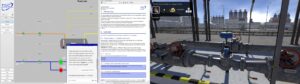
The 3D plant is not simply a visual representation running alongside the simulation. The two are linked in real time, allowing actions taken by a field operator within the virtual environment to affect the simulated process and control-room displays.
Learners can navigate the plant, locate equipment, read indicators and operate valves, switches and controls. Field and control-room trainees can work together on activities such as start-up, shutdown and fault identification, developing the communication, teamwork and decision-making skills required during real operations.
This creates a much closer connection between process theory, control-room information and activity within the plant itself.
Ready-to-use simulations with room to grow
Developing effective simulation training does not always require a large bespoke project.
TSC offers an extensive range of ready-to-use, or off-the-shelf, simulations covering introductory process control, individual equipment, unit operations and complete process plants.
These allow universities, colleges and training organisations to introduce practical simulation quickly, choosing models that support their existing courses and learning objectives. Learners can progress from pumps, vessels, heat exchangers and control loops to processes such as separation, distillation, gas treatment and compression.
For organisations with specific operational requirements, simulations, scenarios and 3D environments can also be customised or developed around a particular plant or training need.
More structured learning and on-demand support
The simulation itself is only one part of the learning experience.
TSC models are supported by defined learning objectives and structured learning materials, including fillable digital workbooks. These help learners work through activities, record observations and demonstrate their understanding.
The TSC AI Tutor provides additional on-demand guidance. Learners can ask questions as they work, reinforce their understanding of process behaviour and receive support with the reasoning behind operational decisions.
This complements the role of the instructor while also supporting self-paced, remote and independent learning.
Automated assessment and measurable progress
Training should demonstrate competence, rather than simply record attendance.
TSC’s automated assessment tools can evaluate learner performance, generate scores and monitor development over time. Assessments can be customised around particular exercises, procedures or learning objectives.
Event logging and session replay give instructors further visibility by recording actions, alarms and responses for later review. Fault injection and instructor variable control also make it possible to test how learners react to changing conditions and unexpected events.
Through Learning Management System integration, assignments can be created within an organisation’s existing LMS. Learners can launch the correct simulation and starting conditions, with results returned automatically for centralised tracking and reporting.
Flexible training without specialist hardware
TSC simulations can support classroom teaching, instructor-led sessions, independent study and remote learning.
They can be delivered on desktop computers or through the cloud, with connected and multiplayer options available where collaboration is required. Immersive environments can also be experienced through compatible VR systems.
Together, these capabilities create more than a piece of simulation software. They provide an adaptable training environment that combines realistic process behaviour, immersive plant experience, structured learning, instructor control and measurable assessment.
Explore TSC’s range of training simulations and discover how we can support your learners, operators and training objectives.
#ProcessSimulation #OperatorTraining #EngineeringEducation #SimulationBasedTraining #InteractiveVirtualPlant #CompetencyTraining #IndustrialTraining